

5 Signs You Probably Need Orthotics
Walk into any pharmacy, and you will see an entire aisle dedicated to foot care. Gel pads, cushioned insoles, and arch support promise instant relief. But for many of our patients, these generic “fixes” act like a band-aid on a broken window: they cover the problem, but they don’t fix the structure.
The key difference?
Over-the-counter inserts provide cushion. Custom orthotics provide correction.
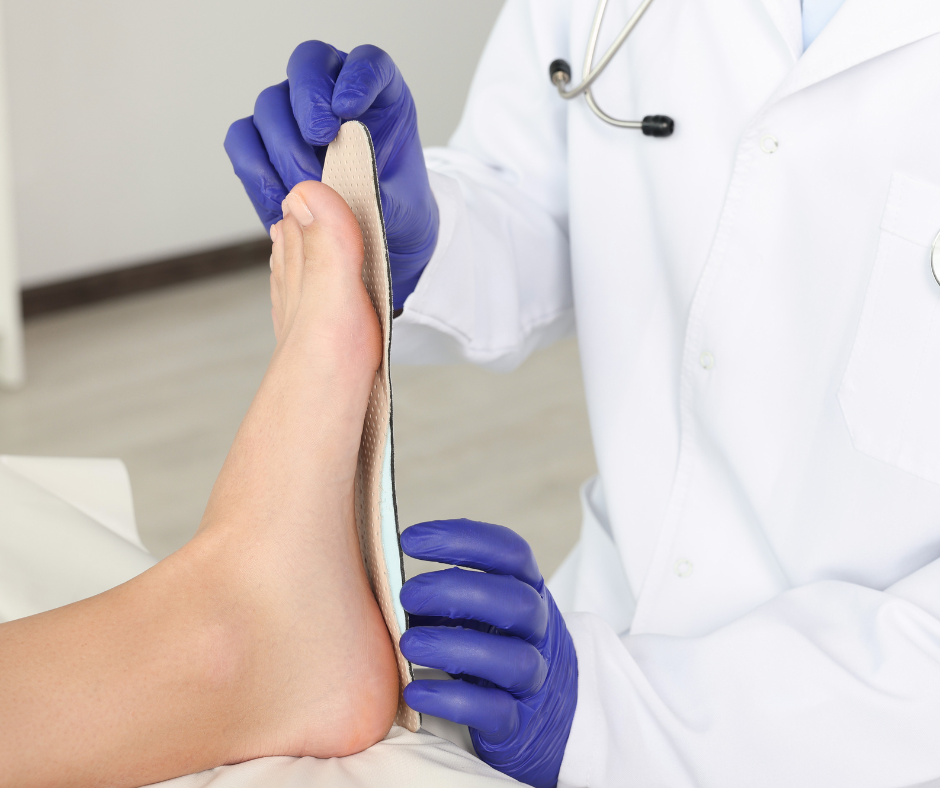
Custom orthotics are medical devices prescribed by a doctor. They are built from a precise 3D model of your foot to realign your joints and ligaments. But how do you know when it’s time to upgrade from the drugstore aisle to a prescription?
By reading this blog (and talking to Dr. Buksh)! Below, Edmond Norman Foot & Ankle covers 5 common signs that you’re a candidate for these powerfully effective inserts.
1. You Have “Morning Heel Pain” (Plantar Fasciitis)
This is the most common reason patients walk through our doors. If your first few steps out of bed feel very painful, your arch is likely collapsing or straining overnight.
- How Orthotics Help: They support the arch and lock the foot into a neutral position, preventing the plantar fascia from overstretching and tearing.
2. You Have Flat Feet or “Fallen Arches”
Look at your wet footprint. If you see the entire outline of your foot with no curve on the inside, you likely have flat feet (pes planus). Without an arch, your foot rolls inward (overpronation) every time you take a step.
- How Orthotics Help: A custom device “builds” a floor for your arch to rest on, stopping that inward roll and preventing the knee and hip pain that often follows.
3. You Feel “Electric” Pain or Numbness (Nerve Issues)
Many people are surprised to learn that orthotics can help with nerve pain. Conditions like Tarsal Tunnel Syndrome or Neuromas occur when nerves in the foot are compressed or pinched by surrounding bones and tissue.
- How Orthotics Help: By correcting the alignment of the bones in your foot, orthotics can open up the spaces where nerves travel. This relieves the pressure (decompression) and stops the burning, tingling, or numbness often associated with nerve entrapment.
4. You Have Bunions or Hammertoes
These structural deformities are genetically inherited via foot type and caused by instability in the foot. Orthotics are an excellent choice for symptom management.
- How Orthotics Help: While an orthotic cannot “erase” a bunion, it can slow its progression. By stabilizing the joint and redistributing pressure away from the big toe, orthotics can significantly reduce pain and delay the need for surgery.
5. You Have Diabetes
For patients with diabetes, a small blister can turn into a serious ulcer.
- How Orthotics Help: Diabetic orthotics are designed with specialized, soft top covers to reduce friction and shear forces. They offload high-pressure areas (like calluses) to prevent skin breakdown before it starts.
Don’t Wait to Seek Help!
Dr. Buksh can perform a comprehensive gait analysis to see exactly how your feet function while you move. If structural issues are found, we can design a custom orthotic that fits your unique needs.
Ready to fix your foundation? Schedule your evaluation today.
Bill Buksh, DPM, works alongside his expert medical staff at Edmond Norman Foot & Ankle to offer superior podiatric care to anyone in need. Pairing thorough, comprehensive remedies for common podiatric conditions with unique specialty treatments for nerve pain, he and his team would be delighted to treat your feet. Contact us to schedule your appointment today.


